.png)
World of Coffee Brussels is from June 25th to 27th, and Algrano will be there on booth #11147.
WOC is a great chance for producers to meet a large number of buyers in a short amount of time. Experience tells us that trade shows are still one of the best ways for producers to find new buyers.
But attending a trade show is a big investment of time and money. And, despite what many people imagine, selling coffee on the floor ain’t easy.
“There are sales that happen at trade shows, but they tend to be more transactional, or based on price,” explains Sales Manager David Palazuelos. “Trade shows are not about selling green coffee there and then. It’s about building relationships for future sales.”
If you’re a producer without a well-known name in the market, how do you turn those conversations into future buyers?
The way to get a roaster’s interest is through good conversations. And the best way to have a good conversation, according to every Algrano sales manager we asked, is to ask good questions.
Whatever you do, don’t say you have the best coffee in your country. Roasters have heard that line a million times already.
Below you’ll find 6 recommendations from three of Algrano’s Sales Managers: David Palazuelos, US West Coast; Rachel Apple, US East Coast; and Emma Haines, United Kingdom.
If you’re heading to World of Coffee or meeting roasters soon, they have a few ideas for you.
.png)
Before the show
1. Make a plan
There’s a lot to organise before a trade show. Flights, accommodation, who’s traveling, what samples you’re bringing.
It’s easy to forget the most important part: what you’re actually going to do when you step onto the show floor.
Rachel strongly recommends making a clear plan. And that starts with answering one question: why are you going?
Do you want to find buyers for larger volumes or roasters who buy smaller lots and pay more for them?
“If you are a farmer who produces 200 bags, you’re probably not approaching the biggest roasters. Smaller roasters in the Roasters Village might be a better fit. Many producers go straight to famous roasters, but those companies already receive too many requests.” Rachel said.
Even a simple plan is better than no plan.
“Choose ten people you want to talk to and define why you want to talk to them,” Rachel says. “Then you’re not delivering the same pitch over and over. You’re trying to make a connection that feels human and memorable.”
There isn’t a public list of every roaster attending World of Coffee, but Rachel recommends starting with the exhibitor list and floor map on the event website.
You’ll find more than 60 roasteries exhibiting, which is already a good starting point.
Look them up online. Check what coffees they roast. See what profiles they like.
Then build your shortlist.
.png)
2. Get your pricing right
Many producers are used to thinking about the coffee sale as ending once the container ships.
But if you’re selling directly to roasters, you need to understand what happens after FOB. That affects pricing, delivery, and whether a deal is possible.
“Producers need to have pricing, volume, and availability information ready before talking to a roaster,” says Emma Haines. “If you’re considering using Algrano for logistics, it’s also a good idea to know the upcoming shared shipment dates.”
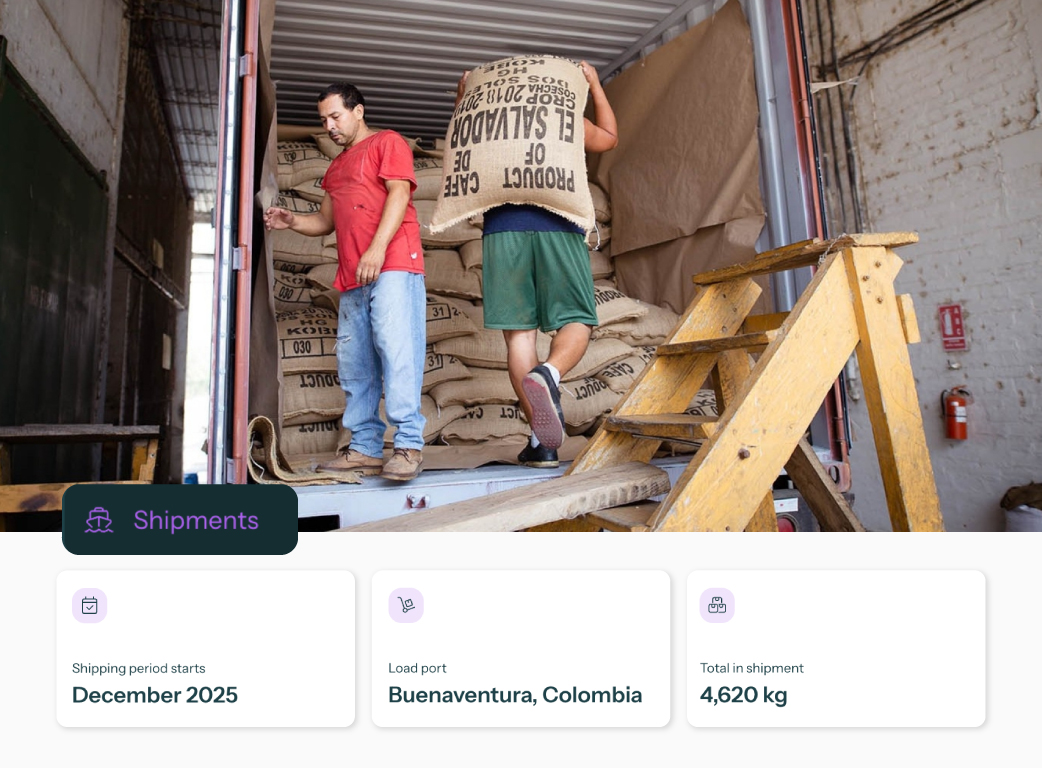
Through shared shipments, small roasters can buy any volume below 100 bags. Coffee can be delivered to warehouses across North America, including California, New Jersey, South Carolina, Texas, Oregon, Washington, Florida, and Ontario.
Pro-tip: most roasters don’t think in FOB prices.
According to Emma, “very few roasters think in FOB terms. If a buyer tells you their budget in dollars per kilo, they’re usually talking about the final landed price.”
In the United States, that typically means an FTO price (Free on Truck).
Knowing how your FOB price (Free on Board) translates into that final price gives you a huge advantage in conversations. It’s one of the reasons importers are often effective sellers.
But with the right information, producers can do the same.
.png)
3. Label your samples well
Roasters return from trade shows with dozens of samples. Many of them end up forgotten in a pile somewhere.
This usually happens for two reasons:
- The roaster doesn’t believe the coffee fits their menu
- Or they don’t know how to buy it
When samples come from importers, they usually include clear information about price, availability, and logistics. That removes uncertainty around delivery, a huge friction factor.
When samples come directly from producers, this information is often missing. Even if the coffee tastes great, it becomes difficult to move forward.
For this World of Coffee, Algrano is making sample labels available for any producer who wants to use them.
They’re not particularly prtty, or made to win design awards. But they will score points on information. They have everything a roaster needs to know: pricing, availability, and delivery details.
To generate a label, producers need to create an offer for their coffee on the platform. That way, roasters can see all the information immediately. And they know Algrano can import the coffee.
Check how to create a Private Offer.
Rachel emphasizes that the material of the sample packs has to be sturdy, because they will go on someone’s luggage and could rip open on the way. Don't use simple ziplock bags.
“Add stickers or ribbons. Anything that helps the sample stand out,” Rachel recommends.
She compares it to waiting for your suitcase at the airport. If everyone’s bag is black, it’s much harder to recognize yours.
Rachel also advises bringing both samples of micro-lots and blender options, if you produce them. High-scoring coffees are memorable. But they’re not always what most roasters need to buy.
Finally, keep sample sizes small: 50g to 100g of green coffee is enough. It’s easier for roasters to carry them home.
.png)
During the show
4. Think beyond business cards
It’s not that business cards don’t work. They just make us lazy.
You can hand out dozens of cards during a trade show and feel productive. But after that, the follow-up is out of your hands. You’re waiting.
Our team recommends doing the opposite: get the roaster’s contact instead.
“One way to stand out is to send them a message right away,” Emma says. “Share your information and suggest following up later.”
Anything informational, like brochures or company details, can also be sent digitally.
“Business cards aren’t going to help much,” Rachel agrees. “They get lost.”
One trick she likes is printing a QR code and sticking it on the back of your phone. It makes sharing your information quick and memorable.
Messaging channels differ by country
Rachel also reminds producers that WhatsApp is not the default communication channel in the United States. Many roasters prefer iMessage, and Instagram can also be a useful contact point.
Instead of cards, Emma suggests bringing something fun or memorable.
“Roasters get given so much stuff at trade shows. Half of it ends up in the bin,” she says. “Brochures are a waste of money. Stickers are better. Samples are great.”
Some producers bring small cultural items, like bracelets made with coffee beans, or local sweets, and small crafts.
Some people even bring bananas. Considering how much coffee people drink at trade shows, and how little time they have to eat, that might actually be one of the smartest ideas we’ve seen.
5. Ask the right questions
“Producers often start conversations with statements roasters have already heard a hundred times,” David says.
But roasters are looking for something different.
According to David, the producers who stand out usually start by asking questions.
Questions help you learn about the market. But they also help you understand whether the roaster in front of you is actually a potential buyer.
Because not every roaster needs your coffee. And that’s perfectly fine.
“Showing that you want to listen also helps build trust quickly,” Rachel says. “It’s impactful when someone wants to hear what your needs are and thinks about them instead of just telling their own story. That can get overwhelming.”
If you’re unsure where to start, here are a few good questions:
Have you tried coffee from [your region or country]?
If they have, ask their opinion. If not, invite them to try it.
How do you usually buy coffee? Do you forward buy? Do you work directly with producers?
This helps you understand their experience level and how familiar they are with direct trade. If they never bought directly, it’s a great opportunity for you to explain the benefits of doing that. But you might also have to explain basic things, like what’s an FOB price.
What coffees do you use for blends? And for single origins?
Roasters often choose coffees they can replace for blends in case their supply chain is disrupted. If you understand their cup profile, you might be able to position yourself as a better alternative or a backup supplier.
How do you sell your coffee?
For example, roasters selling through supermarkets usually want consistent profiles and competitive prices. Roasters running subscriptions often prefer small lots and unique processing methods. Knowing this tells you what to offer and which samples to give.
What would be the next step to working together?
If the conversation is going well, this is where you move forward: exchange contacts, leave a sample, and suggest a follow-up conversation. The follow-up is key to getting deals done.
6. Invite roasters to grab something to drink
Standing in the middle of a busy trade show isn’t always the easiest way to have a natural conversation.
It helps if you’re doing something together.
David’s trick is simple: invite the roaster to grab a drink or walk somewhere nearby.
“I do that all the time,” David says. “If someone is willing to grab a drink or food together, it usually means they’re interested.”
During World of Coffee, Algrano will have drinks and snacks available at our booth.
You’re welcome to invite roasters there and use the space for a relaxed conversation. Our team can also join if you’d like support explaining pricing or logistics.
Come say hello in Brussels
If you’re attending World of Coffee Brussels, stop by the Algrano booth #11147 to meet the team and learn more about how we support producers.
We’ll have a space for meetings and conversations. If you want to bring a roaster to talk, just check with us when the table is available.
We look forward to seeing you there!