.png)
Hero image: Fazendas Dutra.
What's happening this season
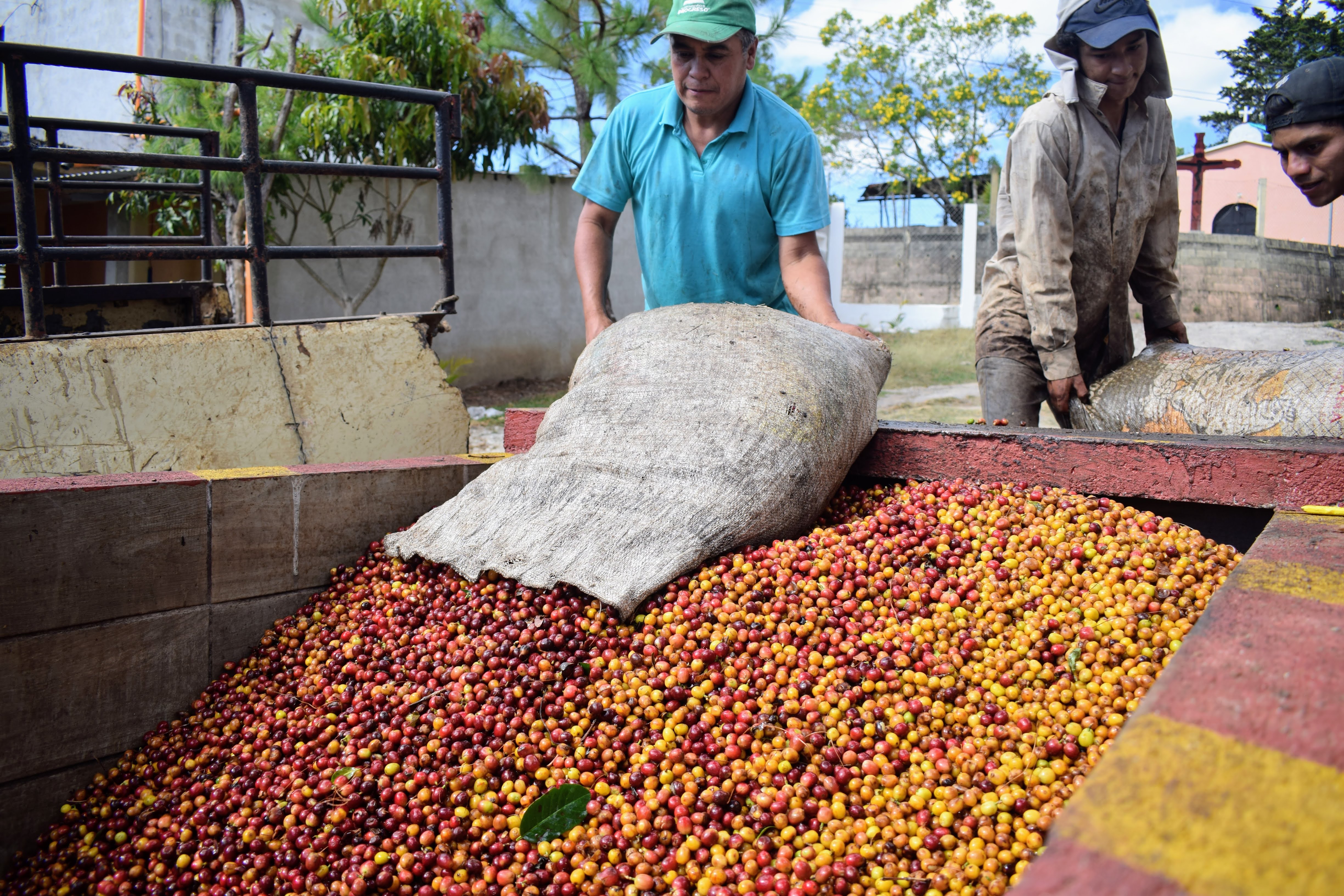
Producers are reporting volume up 10-15% year on year, with quality holding steady across the board. The complication is timing: many Brazilian producers harvest all at once, picking at the moment of peak cherry ripeness rather than continuously over several weeks. This year, that moment arrived late. Unripe cherries and unseasonal rain pushed the season back from its usual June peak.
Lower altitude coffees are being harvested now. Higher-grown lots are generally still running behind. Most producers expect the bulk of the crop to be ready from now onwards, with more coming online through the rest of the season.
.png)
Market volatility is part of the picture too. Sharp price swings have made some producers reluctant to commit to fixed offers. At least one paused a listing to wait for the market to settle, a reminder that this is a season worth watching closely rather than assuming it will run on the usual schedule.
A season of two harvests
Nationally, Brazil's 2026 crop is on track to be one of the largest in recent years. Early reports estimated near 75 million bags. They have settled closer to 70 million as the harvest has progressed, and that figure is expected to hold.
"It's a big harvest. I wouldn't call this a bad year at all," says Roberta Armentano of Itah Comercial Exportadora, an exporter working with producers across Minas Gerais and the Cerrado. "What happened is that we had rain during what's normally our dry harvest window, in June and July. Coffee drying on the patio got rained on, dried out, then got rained on again. And that shows up in the cup."
.png)
That wet-dry cycle, not the volume, is behind this season's real complication.
"I'd estimate that's touching somewhere around 25 to 30% of the coffee I'm seeing," Roberta says. "The rest is shaping up well, and we've had no rain since late July, which is letting the later lots dry the way they should."
So the harvest isn't short on quantity. If anything, there's more coffee moving than there was a year ago, when offers were much harder to come by. What it needs is a bit more care in selection. Producers are prioritizing selling their rain-affected coffee first, while holding on to their best lots for the ones they already have a relationship with or for higher prices.
That puts a premium on roasters getting specific, early, about the exact profile they're after.
Renewed access to the US market
For a lot of US roasters, this is also the first year in a while that sourcing Brazil has felt straightforward. Trade conditions between the US and Brazil, which disrupted the market through much of 2025, have eased considerably this year.
Brazil is, for many roasters, the backbone of the blend: the single biggest-volume purchase of the year, the coffee behind house blends and everyday offerings. Combined with a bigger harvest and a range that spans certified Organic and Fairtrade lots to high-volume blending coffee, this is a strong year to (re)start sourcing Brazil through Algrano.
Why direct relationships matter more this season
A market moving this fast and this unevenly is exactly where direct sourcing earns its keep. Algrano's sourcing team is in regular, direct contact with producers across Brazil, tracking offers and sample timelines as they shift. Long-term relationships also tend to mean steadier pricing and better prioritization when supply is tight in places: producers who know a roaster will be back next year have less reason to chase the highest bidder for every lot.
That range is wider than usual this year, too. Several producers are offering through Algrano for the first time in 2026, including Toca da Onça a family farm in the south of Minas Gerais, in Mantiqueira de Minas.
.png)
Toca da Onça is run by Stuart Swan and his mother, Luciana, who took over the farm in 2022 and shifted its focus to specialty coffee and quality. He described a harvest that's later than most this year. Partly by nature, partly by circumstance.
"We're at around 1,000 to 1,200 meters, so our cherries mature a little later to begin with," he says. "This year, on top of that, we had some very cold nights and very hot days, and rain when we shouldn't have had any. So everything got pushed back further."
The results have been worth the wait: the farm's first lot of the season cupped at 86.5 points. Now listed at Algrano: Toca da Onça Sweet Natural.
"That was a nice surprise," Stuart says. "It looked like it might have dried too fast, with some black beans mixed in, so we worked hard on the drying to get the best out of it. It paid off."
Alongside the coffee, the farm has been building out regenerative practices: cover crops between the rows, native forest restored beyond Brazil's legal reserve requirement, and annual soil testing with their local cooperative.
A snapshot of the season
More producers are coming online through the rest of the season, and the marketplace will keep updating as they do:
- Roberta's ITAH has 12 lots available and many samples, including the roasters' favorite Bossa Classic SCR 17/18
- APAS has 3 offers live now, with 2 samples currently available.
- Fazendas Dutra Organic Coffee is running close to its normal harvest cycle, with little delay. 2 offers are live now, and all samples are available today.
- Farmers Coffee has all offers online and most samples.
- Fazenda Soledade has 3 offers & samples online.
- Coopfam has its 2 offers and samples online.
- Sancoffee has 3 offers currently online.
What this means for sourcing plans
The practical guidance this season: don't wait for the full picture before making a plan. Offers are already live, more are coming online, and, as Roberta noted, the best-quality lots will be guaranteed to people who decide first. Getting specific now about volumes, quality needs, and certifications means being ready to act the moment the right lot appears.