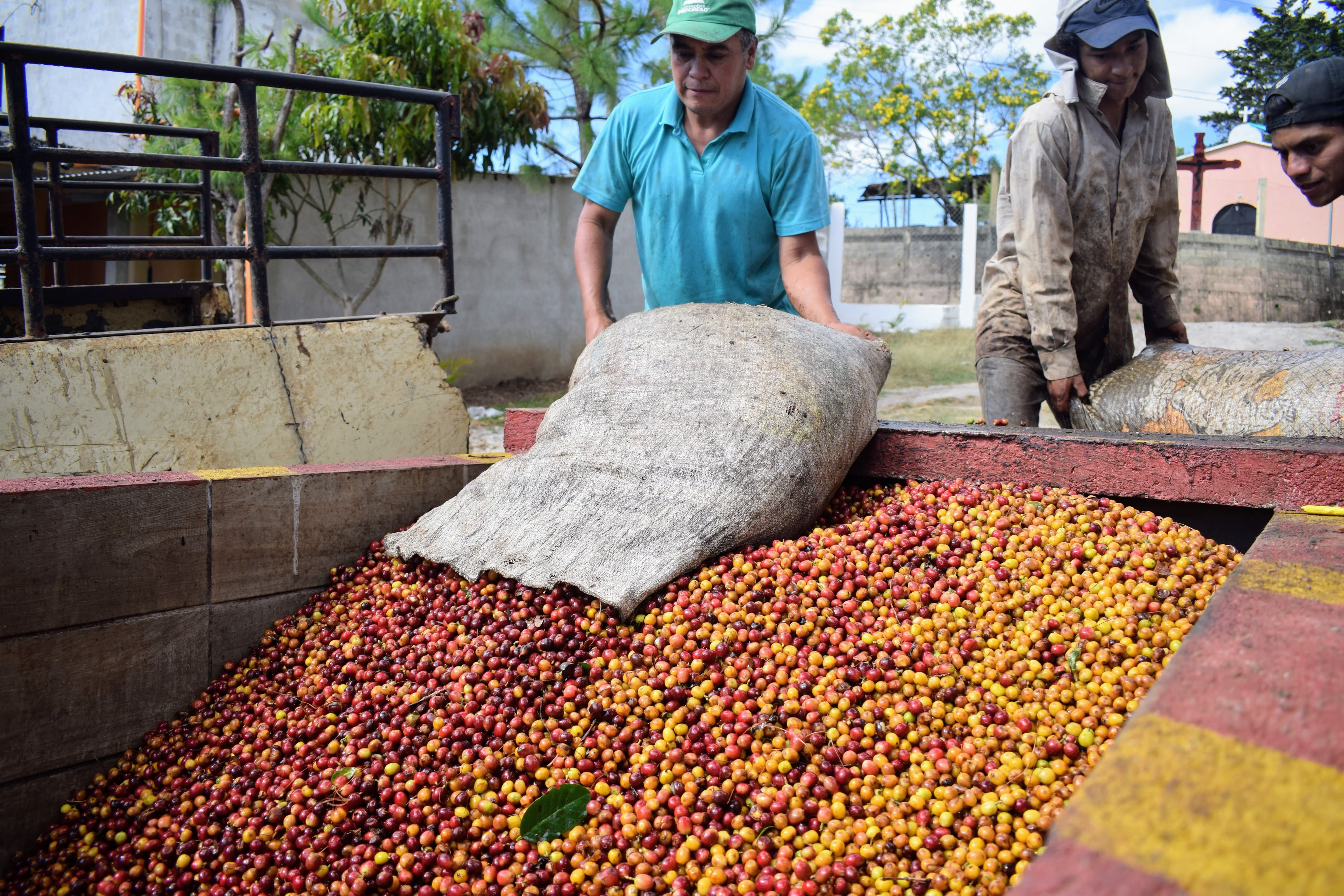
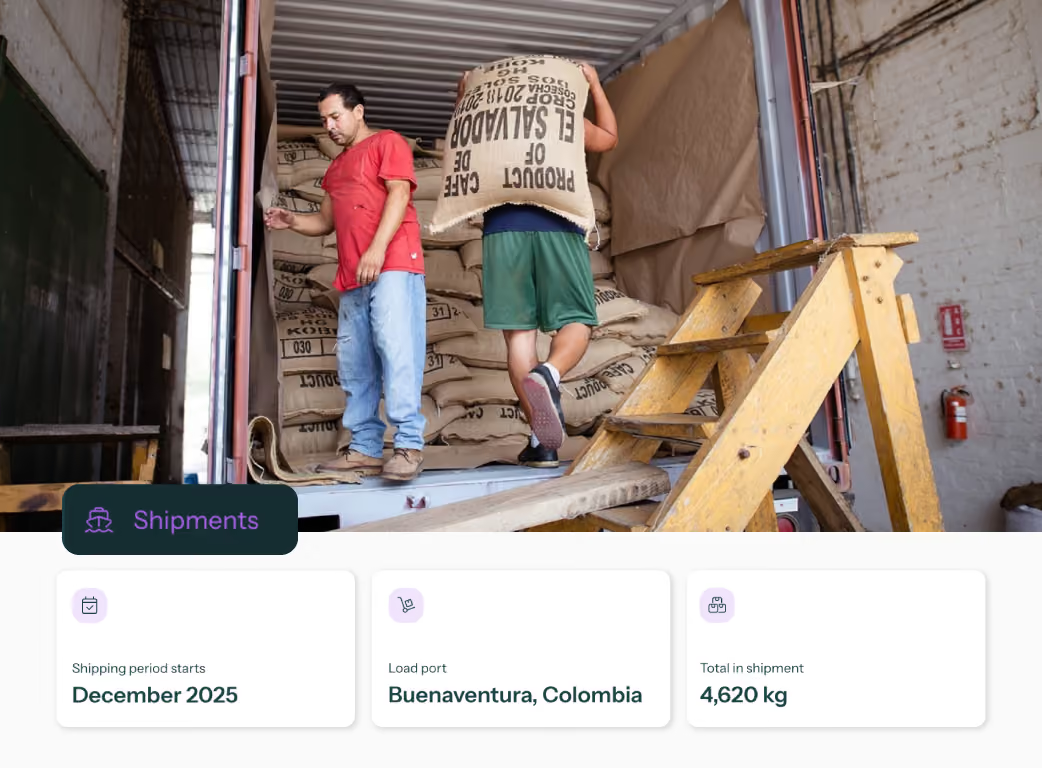
Roasters don't come to Algrano to read about producers. They come to buy coffee. That’s what the numbers show us. Nearly 700 roasters check the live offer list every month. That's about three times the number who visit a producer profile.
Your profile still matters. It's where buyers go back for the full picture once you've caught their eye. But the catching happens on the offer page. That's your shop window, and a lot of producers do not invest in decorating their window display enough.
Here's how to make the most of your offer page, with real examples from producers who already do it well.
The short version
- The offer list gets 3× the traffic of your profile. Put some effort into it.
- Check which photo is first on your lot page: that's the one on the tile.
- Put a person on it.
- Use the name to say what the tile doesn't already say.
- 3–4 photos on the lot page, all showing different things.
- Write the story as yourself, in short paragraphs, with real numbers and facts.
- If a sentence could be said by anyone, delete it.
Roasters are scrolling through hundreds of these. You have a few seconds to grab their attention. Make them count.
How the roaster actually finds you
When a roaster browses coffee, they land on a list where every offer is a tile.
The list is sorted by availability: offers with samples in stock go to the top, offers without samples sink to the bottom. Roasters can also filter by price, score, popularity and freshness.
Each tile shows:
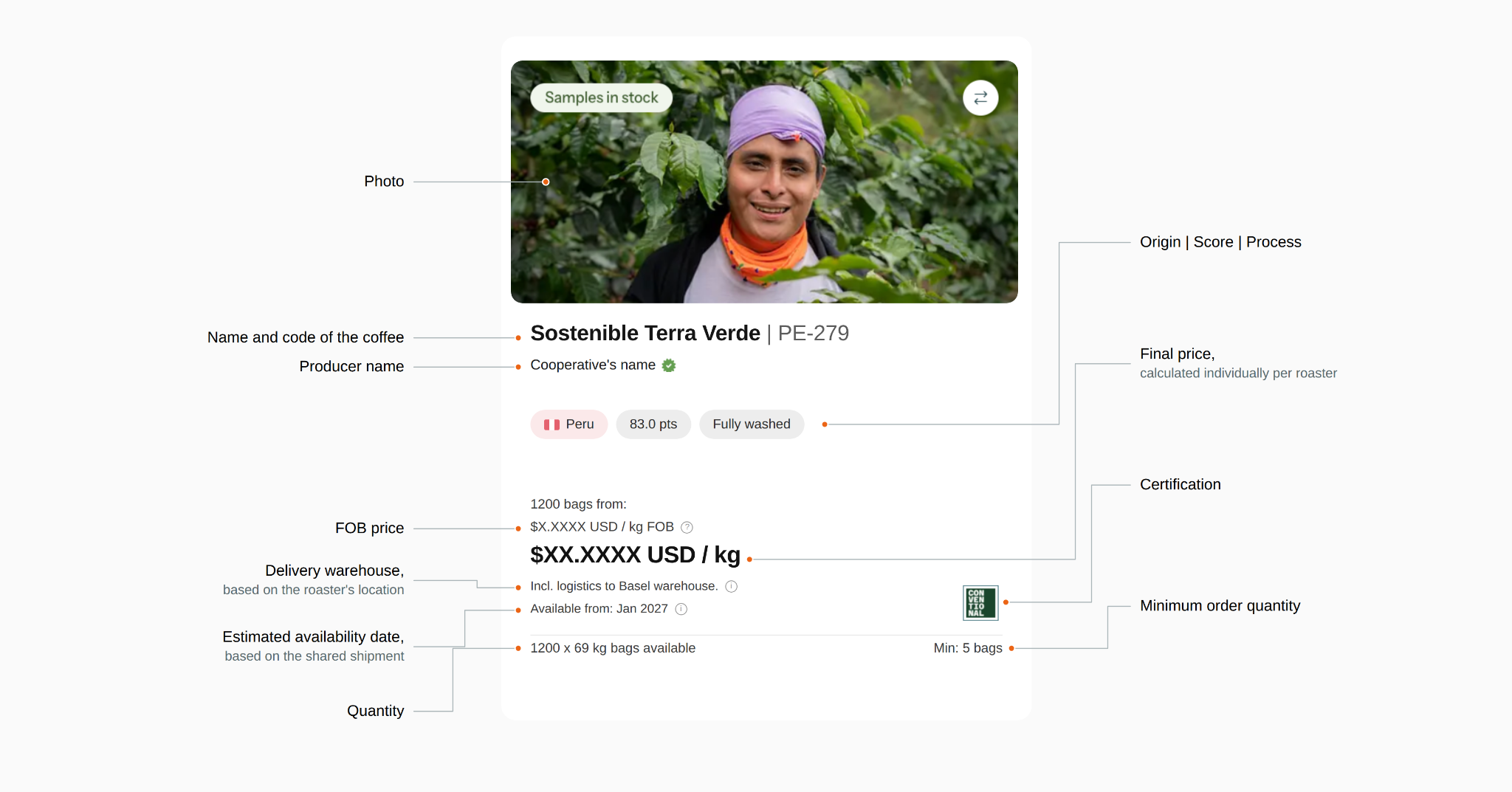
- Name and code of the coffee
- Photo
- Producer name
- Origin | Score | Process
- Quantity
- FOB price
- Final price, calculated individually per roaster
- Delivery warehouse, based on the roaster's location
- Estimated availability date, based on the shared shipment
- Certification
- Minimum order quantity
All of that comes from mandatory fields. You fill them in once and the tile builds itself.
Which leaves you two things to actually decide: the photo and the name of the coffee lot.
The photo
The image on the tile is the first photo you uploaded to the coffee lot page. Here's what everyone is currently using:
- 35%: cherries and coffee being processed
- 30%: people
- 20%: landscapes
- 10%: green coffee samples
- 2%: illustrations
If every third offer is a close-up of red cherries, yours isn't a photo. It's camouflage.
What to do about it:
- Use people. Harvesting, cupping, at the warehouse, in the field. A face is the one thing a scrolling roaster's eye is more likely to stop on.
- Think twice about photos of cherries. They're beautiful but they're everywhere. Being the third red tile in a row doesn’t help you differentiate.
- Keep green samples off the tile. At that size, a green sample is a small grey rectangle. Save it for the “About the coffee” section, where it can be visualised properly.
- Skip logos and jute bags. Your logo is lovely. It also tells a roaster nothing about this coffee. A stack of sacks says the same.
- Don't use the same photo for all your offers. Ten offers with the same picture look like there’s something wrong.
The lot name
The name is free space to say something the information on the tile isn't already saying.
Good things to put in it:
- The region, as specific as you can get
- The variety
- The grade
- The producer's name
- The specific name of the process, if it's experimental or unusual
- Value markers like women's coffee, project coffee, carbon neutral, family farm…
One thing to leave out: certifications. They're already on the tile as a badge. You don't need to say it twice.
We wrote a whole separate piece on naming here →
The coffee lot page: your prime real estate
This is where the clicks land, and where you do business. You can have multiple photos, tell a story, and introduce yourself.
And it's where a lot of producers go quiet. The story field sits empty, or holds three lines that could describe anybody's coffee.
The photos
Photos carry information, same as words. A cherry shot tells a roaster about selective picking and ripeness at harvest. Useful, but you don’t need more than one.
The problem is when all four photos are about the harvest. Then you've told the roaster one thing, four times.
Try this instead:
- Pick 3 to 4 photos. That's the layout the page is built for. More than that and the roaster might not scroll down enough to read your story.
- Always include people. Farmers, pickers, washing station crew, warehouse staff.
- Vary the subject. People, the landscape, harvesting, an agronomist visit, a farming practice you're proud of, processing, cupping, the warehouse.
- Leave the logo on your profile page.
- Test illustrations before publishing them. Only 2% of offers use them, so you'd stand out. Just know the platform picks the main image at random on each visit, and the main image is cropped vertically on the lot page. A beautiful wide illustration may end up missing the edges.
- Something unposed and creative is more than welcomed. Not every photo has to look professional or like a brochure.
The coffee story
This is where you answer the question the roaster is actually asking: why this coffee, and why you?
Consistency, defect sorting, altitude, and flavour complexity are all things they want to know about. But also: what makes you a good partner? Sustainable practices? Community investment? A profit-sharing system that actually rewards farmers?
Example 1:
Statistically, women often carry the heaviest workload on coffee farms. They work in the fields, manage post-harvest processes, care for the children, and support the workers — yet traditionally, men are the ones who appear in the credits and receive the recognition. Not here. This blend intentionally places the spotlight where it truly belongs — on the women whose hands make it possible.
Example 2:
Most farms are shaped by what came before them: existing fields, inherited infrastructure, established habits. When Mount Sunzu's founders arrived near Mbala in northern Zambia, the land had lain largely unused since the 1960s. There was no coffee operation and almost no infrastructure. The start was difficult, but it allowed one rare question: what would a coffee farm look like if every part were designed to work together?
You can also link out from here, taking roasters to your website, your social media channels, brochures, impact reports, etc.
Make it readable
The more you write, the more the formatting matters. Very few roasters reach the bottom of a wall of text with joy. A few things to consider when writing:
- Write short paragraphs
- Add headers to break different sections (Processing, History, etc)
- Use bullet points
- Highlight keywords in bold
- Add a couple of extra images to break it up
Give context
Roasters don't know what coffee production looks like in your region. They can't tell you're different unless you tell them what you're different from.
Example 1
Traditionally, Ugandan smallholder farmers of Elgon process at the farm or household level, creating the variability that lends itself to inconsistency and a high fade factor. This has created an unfortunate stereotype that Ugandan coffee cannot be stable.
To challenge this narrative, Mountain Harvest invested its first three years into understanding the causes behind this inconsistency — building quality-focused education, teaching regenerative practices at the farm level, and drastically changing its buying strategies.
(...)
Now, instead of tired and faded coffee, Mountain Harvest has proven that Ugandan coffee is stable, balanced, and consistent.
Example 2
Caturra Chiroso has earned a reputation as "the Gesha of Colombia" thanks to its vibrant and expressive profile. In this natural process, it delivers an intense tropical character with notes of mandarin and ripe peach, layered over a juicy, sweet citrus acidity. (...)
Write as yourself
Especially if you're a farmer running your own operation rather than a cooperative or exporter selling someone else's coffee.
Third person is for faceless companies and marketing teams. It makes a personal story read like a press release.
Example 1
I am Augusto Borges Ferreira, a fourth-generation farmer from the Borges and Ferreira families and the forefront of this company. In our lands, where the altitude reaches 1.090 to 1.350 meters and the rain blesses our plantations with an average of 1.250mm to 1.400mm per year, each coffee bean carries the unique flavor of this privileged terroir.
Example 2
My grandmother started working the land when she was a child, and now, more than seven decades later, she is still going strong. It was she who taught me to pick coffee and take care of the land during holidays, when I was not in school.
Be specific. Numbers beat adjectives.
Buzzwords are what people write when they don’t know what to say. Instead of simply saying you are “sustainable” or “put care into your work”, give examples that show how you do it.
Example 1
On top of the local plaza price, the cooperative pays an extra 5,000 COP (around USD 0.11/lb) after the sale of the coffee. There are two second payments that can vary from USD 0.04/lb to USD 0.11/lb in total. How much farmers are paid depends on what the administrative council — a group of producers elected to represent the member communities — decides.
Example 2
Beyond Borders Program. A smallholder programme created in 2012 to promote prosperity among growers in the Campo das Vertentes region and give them access to the specialty market.
3 associations · 157 small growers · 3,497 exported bags (60 kg) · 61% premium paid above local market · US$ 23,985.46 contributed by buyers
Don't make claims if you can’t back them up
Big claims, like “this is the best coffee in [insert country name]”, don't make roasters feel confident if there are no facts to back them up. They read as pushy and fake.
Someone might write something like "each step, from planting to harvest, reflects care and dedication." If they don’t say what the steps are and how they care for the coffee, the roaster won’t know what that means.
Read this paragraph:
"(...) family farmers produce exceptional coffee while nurturing both the land and their community. Through sustainable practices and a deep commitment to environmental stewardship, they cultivate high quality coffee beans that are celebrated worldwide."
Not only is the producer making very big claims about the coffee, they’re not giving any details about their practices and values. It reads like green washing.
Tell a story, not a process
How the coffee was processed belongs on the page. But it shouldn’t be the full story. This is a place for you to talk about your company too, as the roaster might never reach your profile page.
Example 1
There's a small island in the heart of Lake Kivu where coffee grows wild and clean — that island is Gishamwana.
Privately owned and part of COOPAC's story, Gishamwana is home to over 28,000 coffee trees, all organically grown in rich volcanic soil, shaded by forest, and protected by its isolation. No pests, no shortcuts — just pure Rwandan terroir. The island is alive with nature: cows, goats, and even an albino rabbit share space with our cherries.
Three hooks that always work
Frequently asked questions
Use questions buyers already asked you as hooks. If one roaster wants to know about it, chances are others do too.
Example
Have you ever tasted Bourbon Ají? Discovered in the mountains of Southern Huila, Colombia, this unique variety is one of the most exciting additions to the specialty coffee world — local tradition gave it its name because of the subtle peppery hint in its fresh mucilage.
Local history
The history of your region, especially the coffee history, adds colour to the story and shows your heritage. In the eyes of roasters, you’re more likely to be a consistent partner if coffee runs deep where you are.
Example
The name Imperial refers to the Imperial Route, used in the 19th century to transport gold. Tropeiros, with horses and wagon carriages, made the journey through native forests and rivers. Today the horses have been replaced by tractors and trucks, and the gold by something just as valuable: coffee.
Local geography
Locating the nearest peaks make people think of high altitude. Naming nearby national parks and preserved areas make them think of agreeable micro-climates. Use these to your advantage.
Example
On the west side, Cerro Pital towers above our fincas, and on the other flanks, Guisayote National Reserve and the Pacayita volcano create ideal conditions to grow coffee. The omnipresence of mountains creates highly beneficial micro-climates, as well as a diverse fauna and flora on and around the plantations, with plentiful natural shade.